Covered parking for employees and customers
Provide shaded parking areas that improve comfort for employees, customers, tenants, and visitors while protecting vehicles from long-term sun exposure.

Generate renewable energy while creating shaded parking areas for employees, customers, tenants, and visitors.
Commercial solar carports and canopy systems provide businesses with a dual-purpose renewable energy solution that combines energy generation with functional shaded parking. WattHub develops custom solar carport systems for commercial properties, retail centers, office campuses, industrial facilities, schools, municipalities, and mixed-use developments nationwide.
Solar carport systems require careful planning around parking layouts, fire lanes, drive aisles, drainage, structural engineering, and accessibility requirements. WattHub helps businesses navigate these complexities while designing commercial solar canopy systems that maximize both energy production and long-term property value.
Beyond energy savings, shaded parking areas create a more comfortable experience for employees, tenants, and visitors while enhancing the overall functionality and appearance of commercial properties.
Provide shaded parking areas that improve comfort for employees, customers, tenants, and visitors while protecting vehicles from long-term sun exposure.
Generate clean, renewable energy directly from existing parking areas to help offset utility consumption and support long-term sustainability goals.

Commercial solar carports can enhance property functionality, improve energy efficiency, and increase long-term commercial asset value.

Shaded parking structures create a more comfortable and attractive environment for visitors, customers, tenants, and employees.

Offset rising electricity costs through on-site renewable energy generation designed to reduce long-term operating expenses.

Transform underutilized parking areas into productive energy-generating infrastructure without requiring additional land development.
What are commercial solar carports?
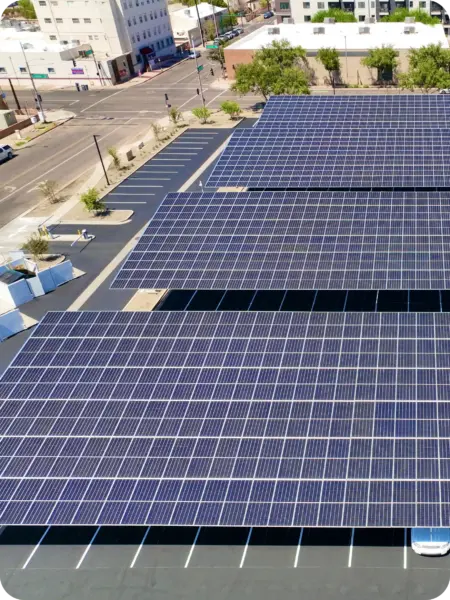
Commercial solar carports are elevated canopy structures installed over parking areas that support solar panels while providing shaded parking. These systems allow businesses and organizations to generate renewable energy without using roof or ground space.
What types of properties benefit from solar carports?
Solar carports are commonly used for:
Any property with large parking areas can potentially benefit from commercial solar canopy systems.
Do solar carports provide the same energy production as rooftop solar?
Yes. Commercial solar carports can generate significant renewable energy depending on system size, panel orientation, and available parking area. In some cases, solar carports may provide even better production potential than rooftop systems due to optimized panel positioning.
How much space is needed for a commercial solar carport system?
The required space depends on parking lot layout, desired system size, and energy goals. WattHub evaluates parking configurations, drive aisles, fire lanes, and operational requirements to determine the best solar carport layout for each property.
Can solar carports help reduce operating expenses?
Yes. Commercial solar carports help businesses offset utility usage through on-site renewable energy generation, which can significantly reduce long-term electricity costs and improve operational efficiency.
Are solar carports structurally engineered for commercial properties?
Yes. Commercial solar carports require specialized structural engineering to support elevated solar arrays, wind loads, drainage considerations, and long-span parking layouts. WattHub helps coordinate commercial solar canopy systems designed around each property’s structural and operational needs.
How long does a commercial solar carport project take?
Project timelines vary depending on system size, permitting requirements, engineering complexity, and utility coordination. WattHub helps businesses navigate the development and installation process efficiently while maintaining clear communication throughout each phase of the project.